


Guide to Selecting Peristaltic Pump Tubing
Selecting the right pump tubing is important for achieving stable flow, good dosing accuracy and satisfactory tubing life in a peristaltic pump. The correct choice depends on the fluid, tubing material, required flow rate and process conditions such as viscosity, temperature, pressure and suction lift.
This guide explains the main factors to consider when selecting pump tubing and tubing size for a peristaltic pump.
How do I select the right peristaltic pump tubing?
When selecting pump tubing, we recommend considering the following:
- Select a tubing material that is chemically compatible with the fluid.
- Determine the required flow rate.
- Select a tubing size that is compatible with the pump and pump head.
- Consider viscosity, temperature, pressure, suction lift and any particles in the fluid.
- Consider requirements for dosing accuracy, tubing life and any required documentation.
- Verify the suitability of the tubing under the actual process conditions.
On the product pages for Drifton's peristaltic pumps and pump heads, you can find compatible tubing sizes and the corresponding flow ranges.
Which tubing material should I choose?
The tubing material must be compatible with the fluid being pumped. This is particularly important when pumping acids, bases, solvents, oils and other aggressive media.
Chemical compatibility depends on factors including the specific tubing material, the chemical, its concentration and the operating temperature. Always check the chemical compatibility of the specific tubing type you are considering.
Drifton supplies pump tubing from several manufacturers. Use the relevant manufacturer's guide when assessing chemical compatibility and selecting a tubing material:
- Innovapure Catalogue 2025
- Masterflex Pump Tubing Selection Guide
- Ami Polymer Chemical Compatibility Chart
Pharmaceutical, biotechnology, food and laboratory applications may also have specific requirements relating to materials, biocompatibility, sterilisation methods or other documentation, for example FDA compliance or USP Class VI. Always check the specifications and documentation for the specific pump tubing.
How do I select the correct tubing size?
The internal diameter of the tubing has a major influence on the flow rate that can be achieved. In general, a larger internal diameter provides a higher flow rate at the same pump speed.
The tubing size must also be compatible with the selected pump head. Not all tubing sizes can therefore be used with all pump heads.
Where high dosing accuracy is required, it can be advantageous to select the smallest internal diameter that can still provide the required flow rate.
If the accuracy requirement is less critical, a larger internal diameter may allow the required flow to be achieved at a lower pump speed. A lower speed can reduce mechanical stress on the tubing and may help extend tubing life.
Always refer to the flow table for the specific combination of peristaltic pump, pump head and tubing size.
What do ID, OD and WT mean for pump tubing?
Pump tubing dimensions are commonly specified as ID, OD and WT:
- ID (Inner Diameter) is the internal diameter of the tubing and has a significant influence on flow capacity.
- OD (Outer Diameter) is the overall external diameter of the tubing.
- WT (Wall Thickness) is the thickness of the tubing wall. The correct wall thickness is important to ensure that the tubing fits the pump head and is compressed correctly during operation.
Always select a tubing size specified for the relevant pump head.
Which pump tubing should I choose for a viscous fluid?
Viscosity affects the flow rate that can be achieved with a peristaltic pump. As viscosity increases, it becomes more difficult for the tubing to refill after being compressed by the rollers in the pump head.
When pumping viscous fluids, it may therefore be beneficial to:
- select a larger internal diameter
- select an appropriate wall thickness
- keep the tubing on the suction side of the pump as short as possible
- minimise suction lift
- reduce pump speed if the tubing does not have sufficient time to refill between compressions
As a practical guideline, Drifton normally recommends peristaltic pumps for fluids with a viscosity of up to approximately 2,000 cP. The achievable viscosity depends, however, on factors including the pump, pump head, tubing size, pump speed and installation.
Please contact us if you need to pump a highly viscous fluid. We can help assess a suitable combination of pump, pump head and pump tubing.
How does pressure affect the choice of pump tubing?
Tubing dimensions influence the pressure the tubing can withstand.
A greater wall thickness can generally withstand a higher pressure than comparable tubing with a thinner wall. For tubing with the same wall thickness, a larger internal diameter will normally have a lower pressure capability than a smaller internal diameter.
The allowable pressure also depends on factors such as tubing material, pump head, temperature and whether the pump is operated continuously or intermittently.
Always check the specifications for the specific tubing and pump configuration when the application operates against back pressure.
How do suction lift and discharge head affect flow rate?
Suction lift occurs, for example, when the pump draws fluid from a container where the fluid level is below the pump inlet.
As suction lift increases, the actual flow rate may decrease. At suction lifts above approximately 2 metres, the effect on flow should be taken into account when sizing the pump.
Both suction lift and discharge head or back pressure can reduce the actual flow rate. A high suction lift can be particularly critical because it can affect how effectively the tubing refills on the suction side of the pump.
For demanding installations, the pump should therefore be selected according to the actual operating conditions rather than solely on the basis of nominal flow data.
Which factors affect the flow rate of a peristaltic pump?
The actual flow rate of a peristaltic pump can be affected by factors including:
- tubing internal diameter
- tubing material and elasticity
- pump speed (rpm)
- fluid viscosity
- suction lift
- back pressure and discharge head
- temperature
- tubing age and mechanical wear
Within the normal operating range of the pump, flow rate is approximately proportional to pump speed. If the pump speed is doubled, the flow rate will therefore typically also approximately double.
The actual flow may nevertheless vary depending on the fluid, tubing and process conditions.
How does pump tubing affect dosing accuracy?
Flow and accuracy data for a peristaltic pump are normally based on measurements under defined test conditions, for example using clean water at room temperature and without significant suction lift or back pressure.
In the actual application, accuracy may be affected by:
- fluid viscosity
- tubing material
- tubing dimensions
- temperature
- inlet and outlet pressure
- suction lift
- tubing age and wear
- pump speed and other operating conditions
Flow and accuracy data should therefore be regarded as indicative until the pump has been tested or calibrated with the actual fluid under the actual process conditions.
If the pump has a calibration function, we recommend calibrating it using the fluid and pump tubing that will be used in the process.
How do I select pump tubing for fluids containing particles?
When pumping fluids containing particles, the internal diameter of the tubing must be sufficiently large in relation to the particle size.
As a general guideline, the particle size should be:
- soft particles: less than approximately 25% of the tubing internal diameter (ID)
- hard particles: less than approximately 5% of the tubing internal diameter (ID)
For example, if the pump tubing has an internal diameter of 8 mm, soft particles should generally be smaller than approximately 2 mm and hard particles smaller than approximately 0.4 mm.
Particle shape, concentration and properties may also influence suitability. For fluids containing a high concentration of hard or abrasive particles, we therefore recommend assessing the specific application.
Overview of pump tubing sizes
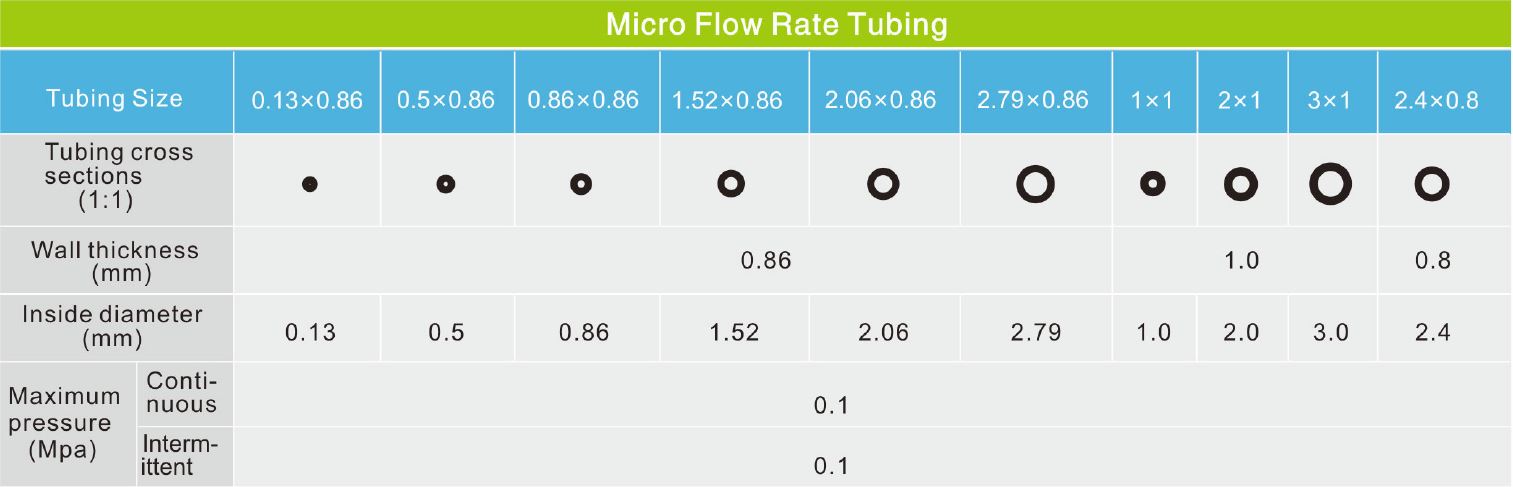
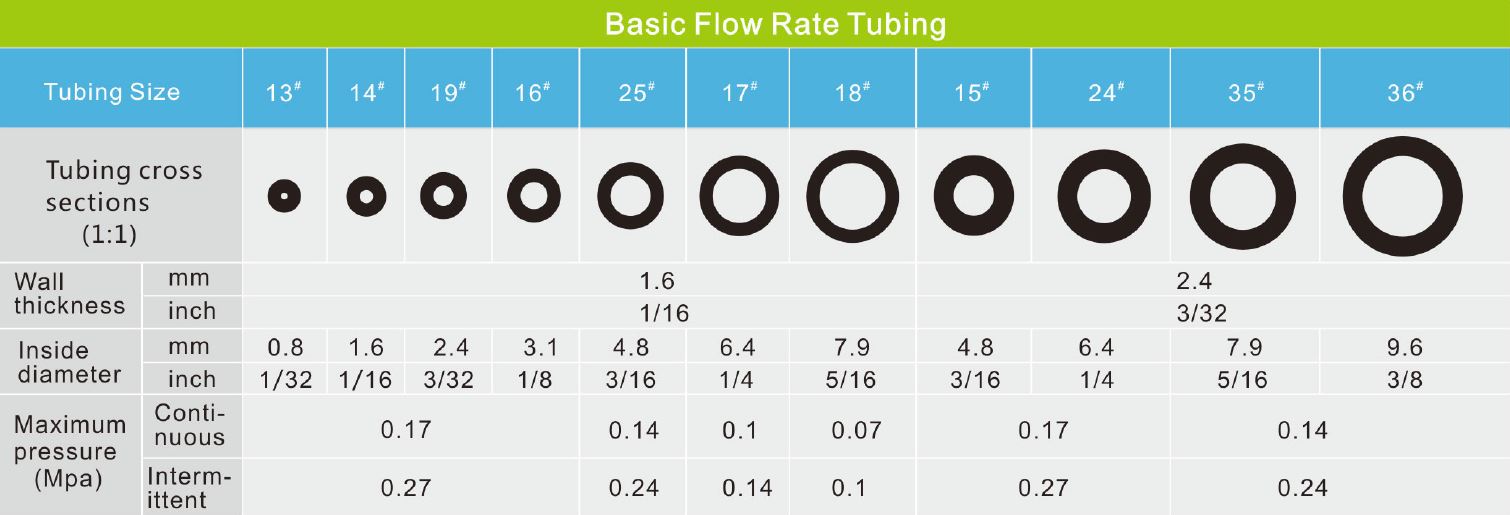
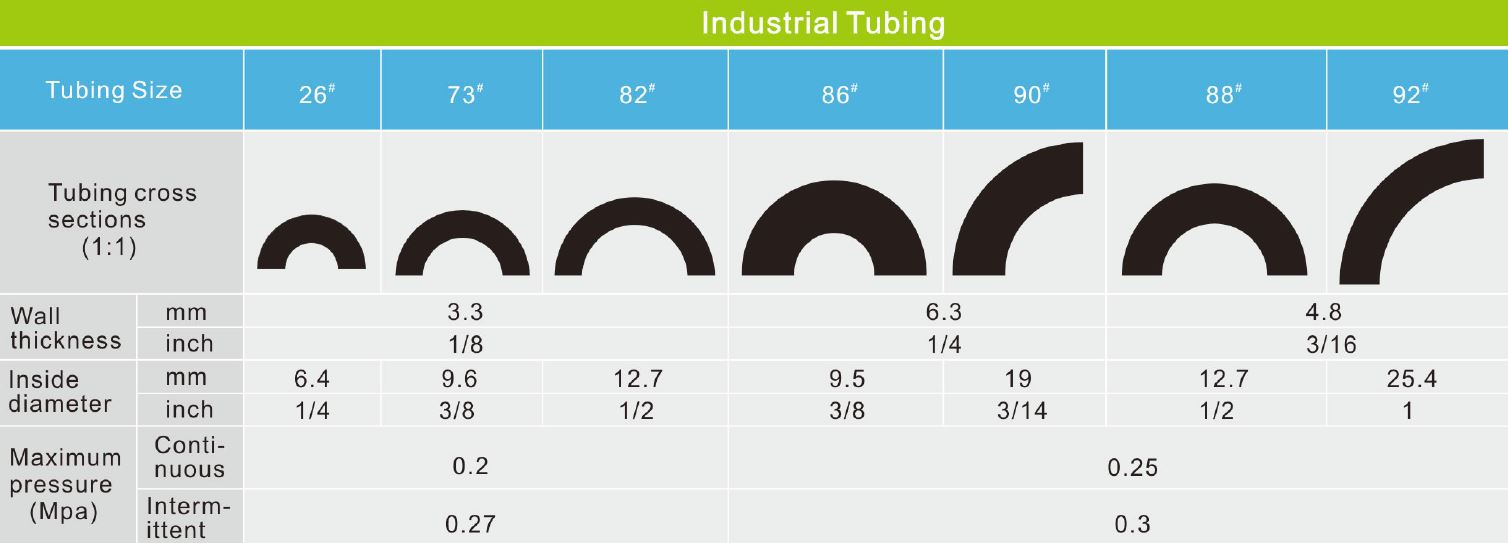
Drifton supplies pump tubing in a range of dimensions for micro flow, standard flow and higher-flow industrial applications.
The tables below show tubing internal diameter (ID), wall thickness (WT) and indicative maximum pressure. The selected tubing size must always be compatible with the specific pump head.
Pump tubing for micro flow
For micro-flow tubing, the tubing size is specified as internal diameter × wall thickness (ID × WT).
| Tubing size (ID × WT) | ID | WT | Max. continuous pressure (bar) | Max. intermittent pressure (bar) |
|---|---|---|---|---|
| 0.13 × 0.86 mm | 0.13 mm | 0.86 mm | 1.0 | 1.0 |
| 0.5 × 0.86 mm | 0.50 mm | 0.86 mm | 1.0 | 1.0 |
| 0.86 × 0.86 mm | 0.86 mm | 0.86 mm | 1.0 | 1.0 |
| 1.52 × 0.86 mm | 1.52 mm | 0.86 mm | 1.0 | 1.0 |
| 2.06 × 0.86 mm | 2.06 mm | 0.86 mm | 1.0 | 1.0 |
| 2.79 × 0.86 mm | 2.79 mm | 0.86 mm | 1.0 | 1.0 |
| 1 × 1 mm | 1.0 mm | 1.0 mm | 1.0 | 1.0 |
| 2 × 1 mm | 2.0 mm | 1.0 mm | 1.0 | 1.0 |
| 3 × 1 mm | 3.0 mm | 1.0 mm | 1.0 | 1.0 |
| 2.4 × 0.8 mm | 2.4 mm | 0.8 mm | 1.0 | 1.0 |
Pump tubing for standard flow
| Tubing size | ID | ID (inch) | WT | WT (inch) | Max. continuous pressure (bar) | Max. intermittent pressure (bar) |
|---|---|---|---|---|---|---|
| 13# | 0.8 mm | 1/32" | 1.6 mm | 1/16" | 1.7 | 2.7 |
| 14# | 1.6 mm | 1/16" | 1.6 mm | 1/16" | 1.7 | 2.7 |
| 19# | 2.4 mm | 3/32" | 1.6 mm | 1/16" | 1.7 | 2.7 |
| 16# | 3.1 mm | 1/8" | 1.6 mm | 1/16" | 1.7 | 2.7 |
| 25# | 4.8 mm | 3/16" | 1.6 mm | 1/16" | 1.4 | 2.4 |
| 17# | 6.4 mm | 1/4" | 1.6 mm | 1/16" | 1.0 | 1.4 |
| 18# | 7.9 mm | 5/16" | 1.6 mm | 1/16" | 0.7 | 1.0 |
| 15# | 4.8 mm | 3/16" | 2.4 mm | 3/32" | 1.7 | 2.7 |
| 24# | 6.4 mm | 1/4" | 2.4 mm | 3/32" | 1.7 | 2.7 |
| 35# | 7.9 mm | 5/16" | 2.4 mm | 3/32" | 1.4 | 2.4 |
| 36# | 9.6 mm | 3/8" | 2.4 mm | 3/32" | 1.4 | 2.4 |
Pump tubing for high-flow and industrial applications
| Tubing size | ID | ID (inch) | WT | WT (inch) | Max. continuous pressure (bar) | Max. intermittent pressure (bar) |
|---|---|---|---|---|---|---|
| 26# | 6.4 mm | 1/4" | 3.3 mm | 1/8" | 2.0 | 2.7 |
| 73# | 9.6 mm | 3/8" | 3.3 mm | 1/8" | 2.0 | 2.7 |
| 82# | 12.7 mm | 1/2" | 3.3 mm | 1/8" | 2.0 | 2.7 |
| 86# | 9.5 mm | 3/8" | 6.3 mm | 1/4" | 2.5 | 3.0 |
| 90# | 19.0 mm | 3/4" | 6.3 mm | 1/4" | 2.5 | 3.0 |
| 88# | 12.7 mm | 1/2" | 4.8 mm | 3/16" | 2.5 | 3.0 |
| 92# | 25.4 mm | 1" | 4.8 mm | 3/16" | 2.5 | 3.0 |
The stated pressure values are indicative. The allowable working pressure in a specific application also depends on factors including tubing material, pump head, temperature and operating conditions.
Which tubing size provides the required flow rate?
Tubing internal diameter is only one of the factors that determines flow rate. Actual flow also depends on the pump, pump head, number of rollers, pump speed (rpm), tubing material and the properties of the fluid and installation.
Always refer to the flow table for the specific peristaltic pump or pump head when selecting the tubing size.
Important information about chemical compatibility and tubing life
Chemical compatibility information is provided as guidance. Chemical concentration, temperature, pressure, contact time, pump speed and the mechanical stress applied by the pump head can all affect the properties and service life of the pump tubing.
The selected pump tubing should therefore be verified with the actual fluid and under the actual process conditions before use in production or other critical processes.
Peristaltic pump tubing is a wear component and should be inspected and replaced at appropriate intervals. In applications where tubing failure or leakage could cause damage to equipment, product or the surrounding environment, suitable measures should be taken to minimise the associated risk.
Do you need help selecting pump tubing?
If you are unsure which pump tubing is suitable for your application, Drifton can help you identify an appropriate solution.
To recommend suitable pump tubing, we would normally require information about:
- fluid or chemical
- concentration
- temperature
- required flow rate
- viscosity
- back pressure, if applicable
- suction lift
- existing pump and pump head, if applicable
- any requirements for FDA compliance, USP Class VI, sterilisation or other documentation
Based on this information, we can help identify a suitable combination of peristaltic pump, pump head and pump tubing for your application.
Visual overview of pump tubing sizes
The illustrations below provide a visual overview of pump tubing sizes for micro flow, standard flow and higher-flow industrial applications.
Tubing sizes for micro flow
Tubing sizes for standard flow
Tubing sizes for high-flow and industrial applications
See our selection of pump tubing.


